
The Berkeley Bit
How the next extraction economy learned to wear a server rack. By Victoria Sable

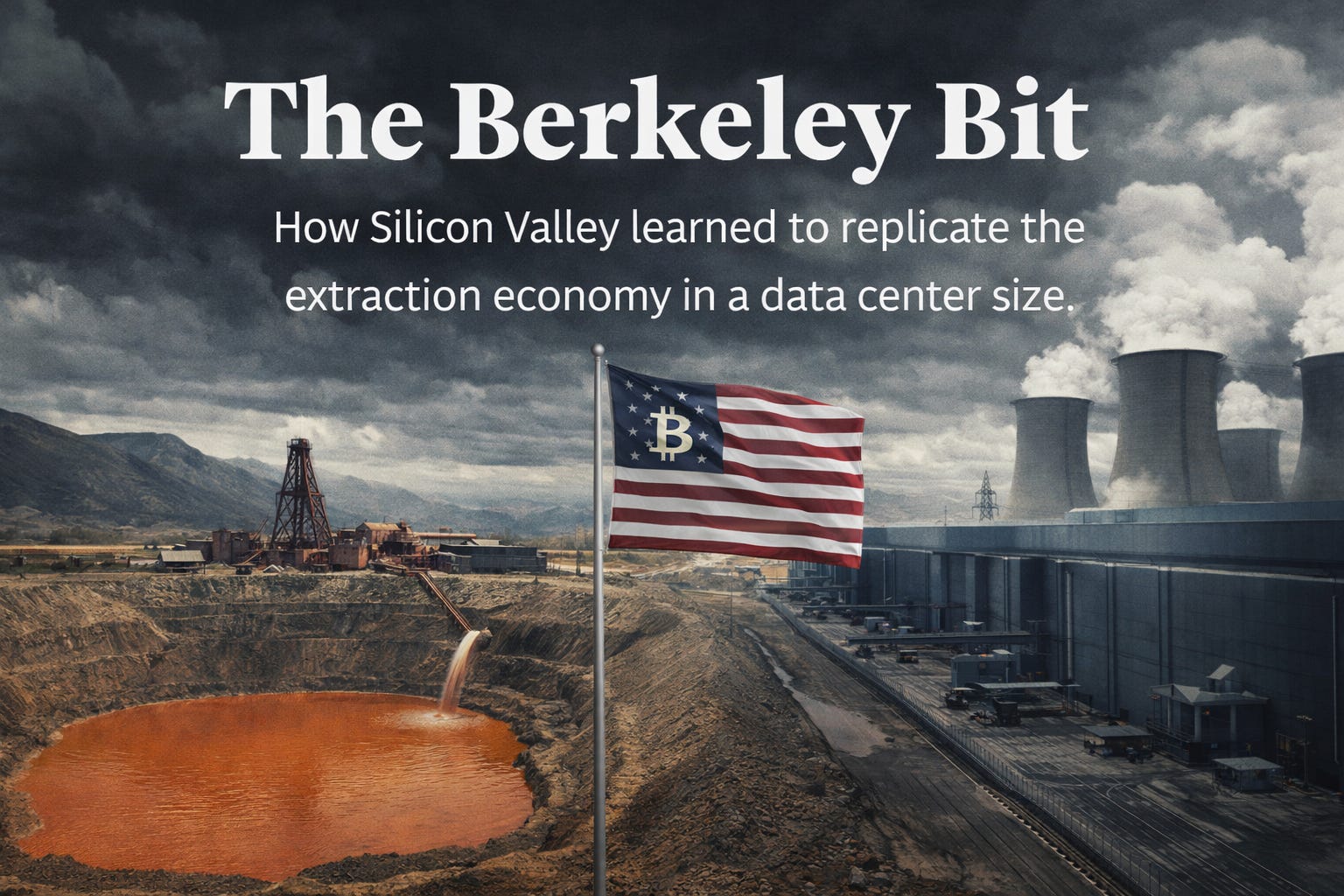
Welcome to the Server Pit
A brief announcement from the Department of Historical Irony
Good news, Butte.
After years of searching for the next great economic engine, the future has finally arrived.
It hums.
It blinks.
And it consumes roughly the electricity of a medium-sized civilization.
Ladies and gentlemen, we are pleased to announce that the next extraction economy will not involve pickaxes, explosives, or smoke stacks.
This time, the extraction will be clean, modern, and quietly air-conditioned.
Progress.
The Old Model
Once upon a time, Butte was told it was sitting on the greatest copper deposit on earth.
The pitch was straightforward:
Jobs.
Growth.
National importance.
The future.
Copper from Butte wired the American electrical grid. It helped build the modern world. It helped win wars.
And in return, the town received a small commemorative lake of sulfuric acid known today as the Berkeley Pit.
History buffs sometimes describe this as a “lesson.”
Investors describe it as a successful project.
The New Model
But don’t worry.
This time is different.
Instead of digging minerals out of the ground, we will simply dig electricity out of the grid and water out of the watershed so that thousands of specialized computers can calculate whether a hot dog is a sandwich.
This process is called Artificial Intelligence.
It requires buildings the size of aircraft carriers filled with machines that politely request:
• a few hundred megawatts of power
• a few million gallons of water
• several generous tax abatements
• and the comforting knowledge that local ratepayers will help with the upgrades
All in the name of innovation.
The Pitch
The pitch is always beautiful.
It arrives wearing the language of opportunity:
“Investment.”
“Technology leadership.”
“Economic revitalization.”
And somewhere in the middle of the presentation, someone will explain that the facility will create:
Eight permanent jobs.
But they will be very intelligent jobs.
The Irony
The strange thing about intelligence infrastructure is that the smarter the machines become, the more resources they seem to require.
Electricity.
Water.
Cooling.
Land.
Transmission lines.
At some point a reasonable person might ask:
If intelligence requires this much brute force infrastructure…
are we sure intelligence is what we’re building?
But that question is generally considered impolite during the investment phase.
The Local Question
None of this means the technology itself is bad.
Technology is never the problem.
The problem is the economic structure wrapped around it.
Because historically speaking, there are two ways these things go.
Model One: Exchange
The community hosts infrastructure.
The community receives lasting economic benefit.
Model Two: Extraction
The community hosts infrastructure.
The wealth leaves.
The liability stays.
Butte, uniquely, has already beta-tested Model Two.
Extensively.
The Small Advantage of Memory
Most towns being approached by the data center boom have no reference point.
Butte does.
Butte knows what it looks like when outside capital arrives promising the future.
Butte knows what it looks like when the trucks eventually leave.
And that knowledge is not cynicism.
It’s leverage.
The Real Question
The question isn’t whether new industries should come to Butte.
Of course they should.
The question is whether the next chapter repeats the old economic script.
Because once the tax exemptions are signed, the grid upgrades financed, and the cooling towers humming…
the negotiating window closes.
And history becomes infrastructure.
Again.
In Conclusion
The good news is that humanity has finally succeeded in creating machines capable of extraordinary feats of computation.
The bad news is that we appear to be building them using the exact same economic model that produced the Berkeley Pit.
Which means the real artificial intelligence test may not be happening inside the server farm at all.
It may be happening in the room where the deal gets negotiated.
And for the first time in a long time…
Butte might actually have the answer key.
Go Deeper: