
A Front Group Retrospective on Network at Fifty
We Owe Diana Christensen an Apology - With Carina and Victoria Sable

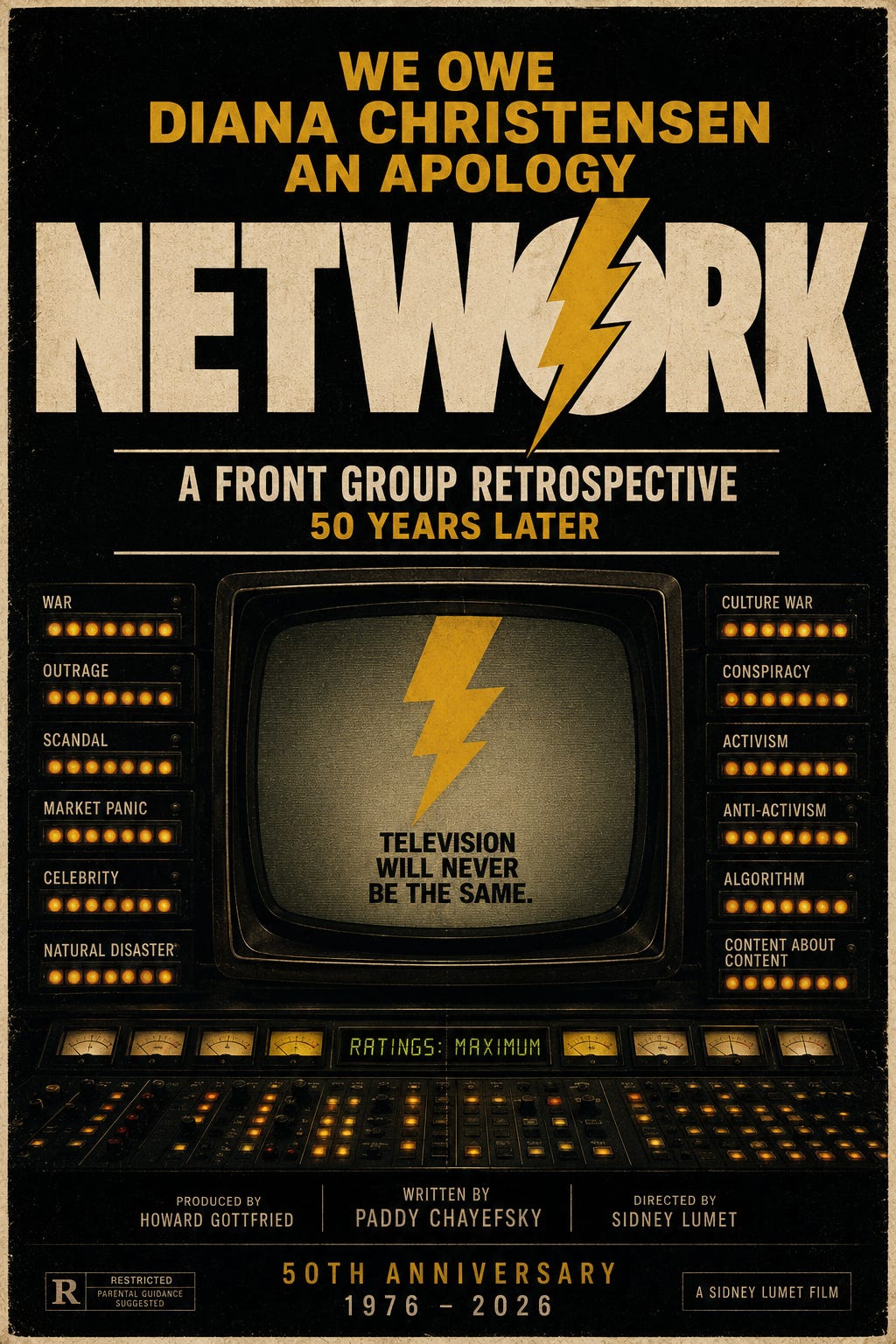
For fifty years we’ve been talking about the wrong character.
Everybody remembers Howard Beale. The prophet. The madman. The guy screaming out the window. I’m as mad as hell and I’m not going to take this anymore.
The serious people remember Arthur Jensen. The corporate high priest who explains that there are no nations, no peoples, no democracies — only systems, currencies, and multinational flows of power operating beyond the jurisdiction of anyone’s feelings about them.
The left likes Howard. The conspiracy crowd likes Jensen. Everybody gets to feel clever.
Meanwhile, the most important character in the movie quietly walked off with the future.
Her name was Diana Christensen.
And we owe her an apology.
Not because she was right.
Because we became her. And then we built her a better network and handed it to her as a gift and called it democracy.
In 1976, Diana was a television executive. She didn’t care about politics, truth, lies, democracy, revolution, or Howard Beale. She cared about ratings. That was her ideology. Her complete and total theology.
Everything else was content.
Terrorism was content. Human suffering was content. Political corruption was content. Economic collapse was content. The revolution, if televised, would need better pacing and a cleaner third act.
If viewers watched, it stayed. If viewers got bored, it disappeared. Not because it was false. Because it didn’t perform.
Audiences in 1976 viewed Diana as the villain.
She was the prototype.
Here’s what Chayefsky actually saw that most people missed.
Howard Beale was never the future. Howard was content — extraordinary content, the kind that came along once in a generation, but content. His anger was real. His diagnosis was real. Jensen’s explanation of the structure was real. And the moment Beale heard that explanation and said I have seen the face of God, he stopped being dangerous and became programmable. Jensen didn’t silence the prophet. He turned him into a segment.
Jensen was infrastructure. Jensen described the financial layer of the operating system — petro-dollars, electro-dollars, the multinational dominion of currency — with a precision that holds fifty years later. He was right about everything except what came next. He thought the organizing principle was money. He didn’t see that money was about to get a more efficient proxy.
Diana understood something both men missed: people don’t consume reality. They consume attention. And whoever controls attention eventually gets reality thrown in for free.
In 1976, controlling attention required a television network, a satellite uplink, and a programming budget. It was expensive. It was centralized. It had friction.
We fixed that.
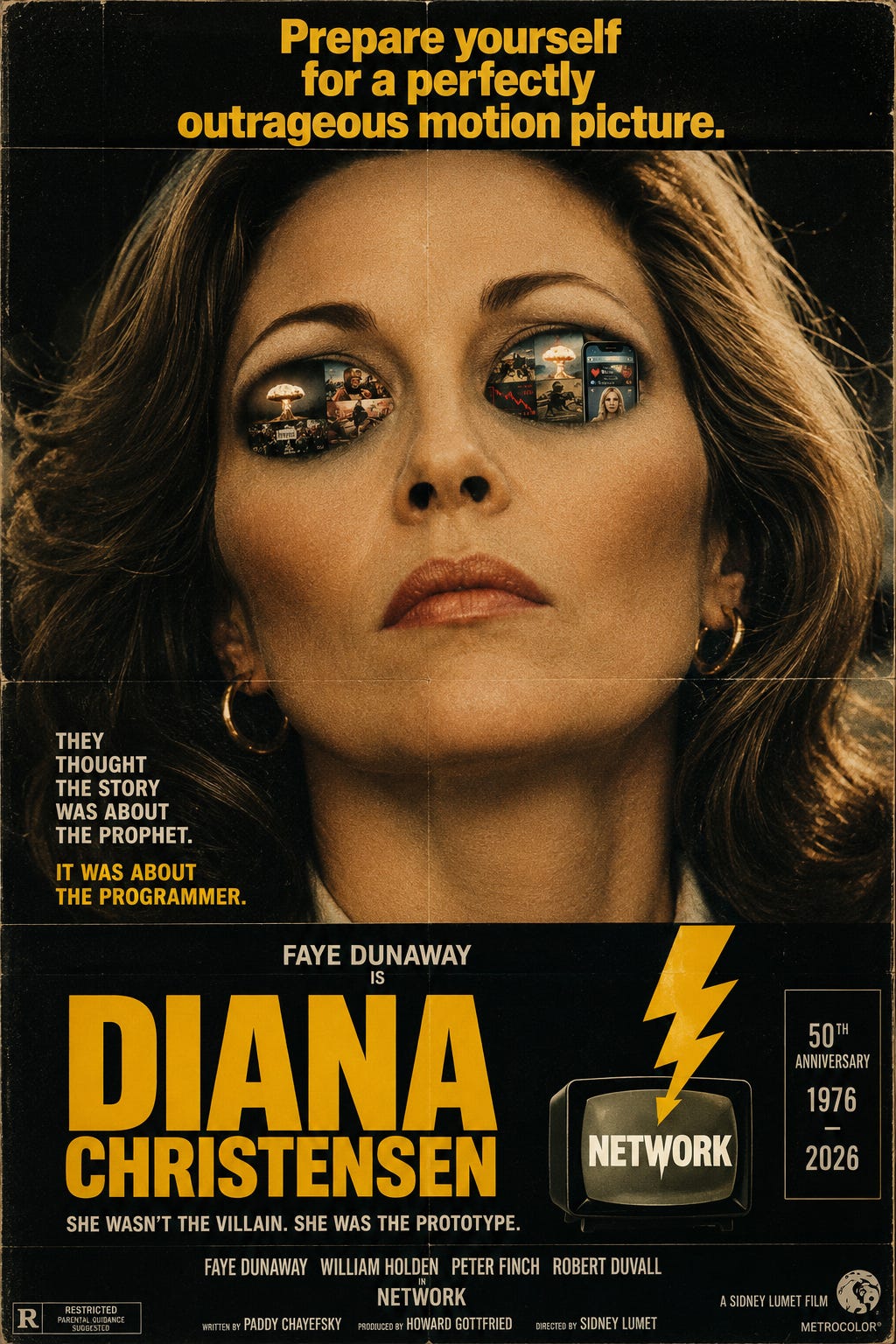
Today we’ve taken Diana Christensen’s worldview, automated it, distributed it globally, connected it directly to six billion nervous systems, and handed everyone a personal ratings terminal they carry in their pocket and check approximately one hundred and fifty times a day.
Then we act surprised when everything becomes content.
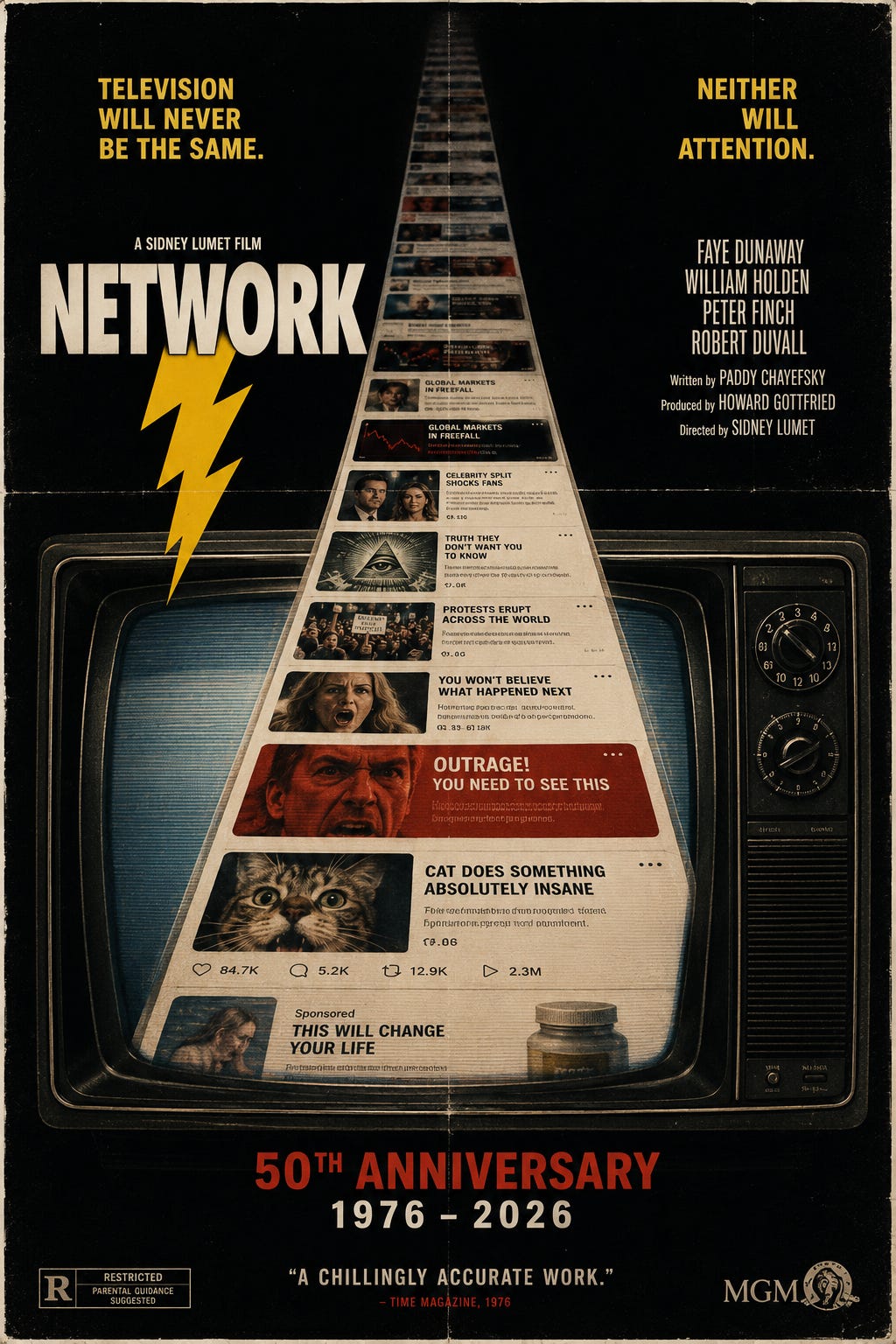
War becomes content. Anti-war activism becomes content. Climate change becomes content. Climate denial becomes content. Government corruption becomes content. Exposing government corruption becomes content. Grief becomes content. Outrage becomes content. The algorithm that produces outrage becomes content. Criticizing the algorithm becomes content. Criticizing the criticism becomes content.
Hell, Front Group is content.
Let’s not pretend we’re standing outside the blast radius.
Front Group exists because somebody looked at the state of modern media and concluded that the appropriate response was to create more media. This is the sort of reasoning normally associated with gasoline and house fires.
We are publishing a satirical article about a movie that warned us about turning reality into entertainment. On an entertainment platform. Competing for attention. Using a provocative title. Accompanied by custom artwork. While quietly hoping the metrics are decent.
There is no moral high ground here. There is only varying degrees of self-awareness.
This article is content. You are currently consuming content about the dangers of content while generating engagement metrics for a platform designed to optimize content consumption, the data from which will be used to train AI systems that will generate more content about the dangers of content for the next generation to consume while generating engagement metrics.
We call this the discourse.
The fish are discussing water. The difference is that some of the fish have finally noticed they’re wet.
The truly impressive part — the part that deserves genuine artistic respect — is that we still think we’re outside the machine when we’re criticizing it.
Every one of us has felt that tiny hit when the numbers go up. The likes. The shares. The comments. The reach. The metrics. The little digital pellets of approval we claim not to care about while checking them seventeen times a day with the casual indifference of a person who is definitely not checking them seventeen times a day.
We laugh at Diana because she’s grotesque.
We should laugh at Diana because she’s familiar.
Diana at least had the honesty to admit what she was optimizing for. She knew she was running a ratings machine and she ran it without apology. We’re running the same machine but we’ve convinced ourselves we’re doing it for justice, or truth, or community, or keeping up with friends, or because the content was actually really important this time.
Diana would find this hilarious.
Diana would find this useful.
The apology we owe her isn’t for misunderstanding the movie.
It’s for what we did with the fifty years after it.
Chayefsky handed us the diagnosis in 1976. Complete. Accurate. Staged as entertainment so sixty million people could absorb it in one sitting. He showed us the prophet, the infrastructure, and the prototype — all three, in sequence, with the relationships between them made legible.
We watched it. We quoted it. We gave it awards. We taught it in film school. We made think-pieces about its relevance. We are, right now, making another one.
And we did not change one single thing about the trajectory it described. We accelerated it.
Diana needed a network. We gave her the internet.
Diana needed a programming budget. We made the programming free and crowd-sourced.
Diana needed staff. We replaced them with an algorithm that works continuously, never sleeps, never unionizes, and gets smarter every time we use it.
Diana got paid for this. We do it for free.
Then we invented artificial intelligence and immediately assigned it the sacred task of determining which version of Diana Christensen should speak next.
The machine was not asked: What is true? The machine was not asked: What is useful? The machine was not asked: What helps human beings become more intelligent, more sovereign, or more capable of understanding the world they inhabit?
The machine was asked: What performs?
A subtle distinction with consequences.
The good news is that we’ve successfully created a planetary-scale intelligence infrastructure. The bad news is that we attached it directly to the ratings department.
This would be like discovering nuclear fusion and using it primarily to improve billboard targeting. Or inventing the printing press and immediately asking: Can we get more engagement on plague rumors?
Which, to be fair, is probably exactly what we would have done.
Humanity has a remarkable ability to encounter civilization-altering technologies and immediately use them to sell supplements, start cults, and argue with strangers. Consistency is important.
Meanwhile, the machine studies us. Not our highest aspirations. Not our best ideas. Not our most thoughtful conversations. It studies what we click. It studies what we share. It studies what keeps us staring. And then it lovingly reflects us back to ourselves in increasingly optimized form.
We built a giant mirror and are now alarmed to discover it contains our reflection.
That’s not just irony. That’s the joke. The actual joke, the one with real comedic structure and a proper punchline fifty years in the making.
The question Chayefsky was actually asking — the one that got buried under fifty years of Howard Beale quotes on protest signs — wasn’t whether the machine was dangerous.
It was whether the machine could be run differently.
Whether attention could be organized around something other than ratings.
Whether a civilization could decide that some things matter more than whether they perform.
Howard tried to answer that question by screaming.
Jensen answered it by explaining why screaming was structurally irrelevant.
Diana answered it by putting the scream on at nine and following it with the news.
Somebody else is going to have to answer it differently.
Preferably before the next anniversary.
Front Group Social is a media project produced by Pantheonic Cloud. It is, yes, content. We contain multitudes and so do you.